Is Commercial Solar Worth It for Small Businesses?
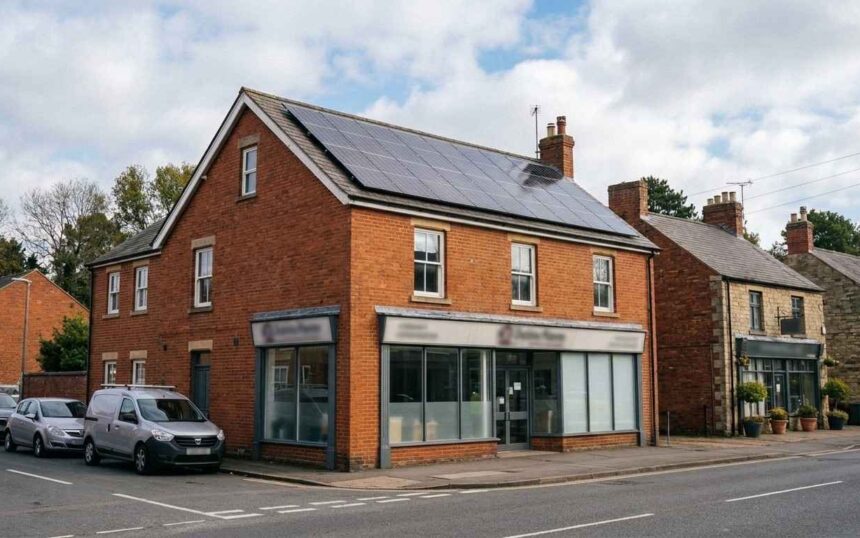
Yes, commercial solar is worth it for most UK small businesses. Systems typically pay back in four to seven years. After that, you’re generating free electricity for up to 25 years. With grid prices sitting around 26–32p per kWh, and self-generated solar costing roughly 5–7p per kWh, the savings add up fast. For businesses with daytime electricity use and decent roof space, it’s one of the strongest returns available right now.
Key Takeaways
- Most small business solar systems pay back in four to seven years.
- Self-consumption drives the biggest savings, more than export income.
- AIA tax relief can cut effective costs by around a quarter.
- Daytime electricity users get the strongest returns.
- A 25-year system lifespan means decades of savings after payback.
For a deeper look at sizing and finance options for your premises, see our full guide to solar PV for businesses.
How Much Does Commercial Solar Cost for a Small Business?
Small commercial systems usually cost more per kWp than large ones. Installation overheads get spread across fewer panels.
- 10–50 kWp (small offices, shops, workshops): £1,000–£1,200 per kWp
- 50–100 kWp (typical SME premises): £600–£900 per kWp
- 100kWp+ (larger units, warehouses): £700–£1,000 per kWp
So a 50 kWp system, common for a small business, might cost £35,000–£55,000 fully installed. That’s before any tax relief.
What Savings Can Small Businesses Expect?
Your savings depend on two things: how much you generate, and how much of that you actually use on-site.
- Every unit consumed on-site saves you the full retail rate, around 22–27p per kWh.
- Unused electricity gets exported and paid via the Smart Export Guarantee (SEG), typically around 8p per kWh.
- Businesses using 60–70% of their solar output on-site tend to see the strongest returns.
A well-sized 50 kWp system generating around 47,500 kWh a year, at 70% self-consumption, can save several thousand pounds annually on energy bills alone.
How Long Does It Take for Commercial Solar to Pay Back?
Most UK small businesses see payback within four to seven years. That’s well within a system’s 25-year lifespan, meaning 18-plus years of near-free electricity afterwards.
Payback speeds up considerably once tax relief is factored in.
What Tax Relief Is Available for Business Solar?
The Annual Investment Allowance (AIA) lets businesses claim 100% first-year tax relief on qualifying solar spend, up to £1 million. On a £50,000 system, that’s a meaningful chunk of the cost offset against your first-year tax bill. Combined with the AIA, effective net costs often drop by around 25%.
Always confirm current AIA rules with your accountant, as thresholds can change.
Is My Business a Good Fit for Solar?
Solar suits businesses that use electricity during the day, not just evenings. Good candidates include:
- Retail units with regular opening hours
- Workshops, trades premises, and light industrial units
- Offices with daytime staff and equipment use
- Buildings with unshaded, south-facing roof space
If your premises sits empty most of the day, the case is weaker. You’d export more than you use, at a lower rate.
Commercial Solar: Cost vs Savings at a Glance
| System size | Typical cost | Annual generation | Typical payback |
| 10–30 kWp | £12,000–£36,000 | 9,500–28,500 kWh | 5–8 years |
| 50 kWp | £35,000–£55,000 | ~47,500 kWh | 4–6 years |
| 100 kWp | £70,000–£100,000 | ~95,000 kWh | 4–5 years |
Real-World Example: A Small Trades Business
Take a Lancashire workshop using electricity mainly between 8am and 5pm. A 40 kWp rooftop system, costing around £40,000, generates roughly 38,000 kWh a year. With 65% self-consumption, the business offsets a large share of its daytime electricity bill immediately. Factoring in AIA relief, the effective cost drops close to £30,000, with payback landing around five years.
This pattern repeats across trades, retail and small manufacturing businesses we see regularly.
What Are the Risks or Downsides?
Solar isn’t risk-free. Worth weighing up first:
- Upfront cost is significant, even with finance options.
- Roof condition matters — older or fragile roofs may need work first.
- Savings depend on how much power you use during daylight hours.
- Planning permission may apply for larger or listed premises.
A proper site survey answers most of these questions before you commit.
Frequently Asked Questions
1. Is commercial solar worth it for a small shop or office?
Yes, if you use electricity mainly during the day. Shops and offices with regular daytime hours typically see payback within five to seven years.
2. How much roof space do I need for commercial solar?
Roughly 5–6 square metres per kWp. A 30 kWp system needs around 150–180 square metres of usable roof space.
3. Do small businesses qualify for solar grants in the UK?
Direct grants are limited, but the Annual Investment Allowance offers 100% first-year tax relief on qualifying spend, which is often more valuable.
4. What’s the difference between self-consumption and export income?
Self-consumption means using the power you generate on-site, saving the full retail rate. Export income comes from selling unused power back to the grid at a lower rate.
5. How long do commercial solar panels last?
Most systems carry 25-year performance warranties. Many continue generating well beyond that, at slightly reduced output.
6. Can I finance commercial solar instead of paying upfront?
Yes. Options include asset finance, leasing and power purchase agreements, alongside outright purchase with AIA relief.
7. Does commercial solar work on a flat roof?
Yes. Flat roofs use ballast-mounted systems, which are often cheaper to install than pitched-roof rail mounting.
8. Will solar panels affect my business insurance?
You’ll usually need to inform your insurer. MCS-accredited installations rarely cause issues, but it’s worth confirming before installation.
9. How do I know if my business uses enough daytime electricity?
A half-hourly electricity usage profile, available from your supplier, shows exactly when you consume power. This determines your ideal system size.
10. What’s the first step to getting commercial solar installed?
Start with a site survey and electricity usage review. This confirms roof suitability, system size, and realistic payback timescales for your business.