
Commercial Battery Storage: Does Your Business Need It With Solar?
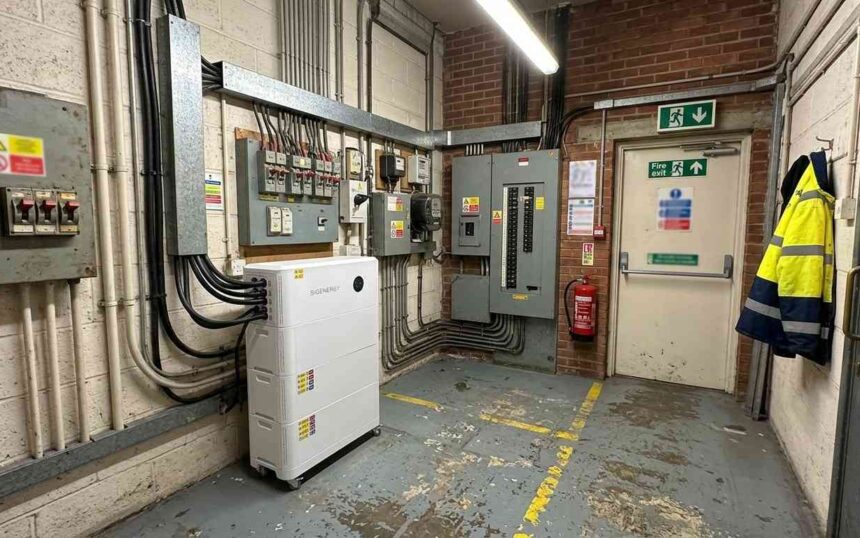
Quick answer: Commercial battery storage is worth it for many businesses. It pays off most when your solar makes a surplus. It also helps if you use lots of power at peak times. A battery stores surplus solar for later. It can also charge on cheaper off-peak rates. With the right inverter, it can keep key circuits running in a power cut. Standard solar alone switches off during an outage.
Key takeaways
- Batteries store surplus solar instead of exporting it cheaply.
- They can cut costs by avoiding peak-time electricity rates.
- Grid-tied solar shuts down in a power cut without backup kit.
- A battery is not the same as a UPS. Many sites need both.
- Size the battery from real half-hourly data, not guesswork.
What is commercial battery storage?
Commercial battery storage is a large battery system for business premises. It stores electricity for use later. Most systems pair with rooftop solar. Some work on their own with the grid.
Modern systems use lithium iron phosphate (LFP) cells. They are stable, long-lasting and handle daily cycling well. A smart controller decides when to charge and discharge.
How does a battery work with business solar?
Think of a normal working day.
- Morning to afternoon. Panels power your site. Any surplus charges the battery.
- Late afternoon and evening. Solar output falls. The battery takes over.
- Overnight. On a time-of-use tariff, the battery can top up cheaply.
Without a battery, surplus solar goes to the grid. Export rates are much lower than import rates. So storing it for your own use is usually worth more.
Five ways a business battery saves money
- More self-consumption. You use more of the solar you generate.
- Peak shaving. The battery covers short demand spikes, reducing peak load.
- Time-of-use savings. Charge when power is cheap, use it when it is dear.
- Lower peak network costs. Avoid the priciest late afternoon and evening rates.
- Less wasted solar. It captures output the grid can’t accept on export-limited sites.
Your savings depend on your tariff and usage pattern. The more evening use you have, the stronger the case.
Does solar work in a power cut?
Not on its own. Standard grid-tied inverters shut down when the grid fails. This is a legal safety feature. It protects engineers working on the lines.
A battery with backup capability changes that. A hybrid inverter or backup gateway can isolate your site from the grid. Selected circuits then keep running from the battery and panels.
Not every battery offers this. If backup power for businesses matters to you, ask about it at the design stage. Decide early which circuits must stay on.
Battery storage vs UPS: what is the difference?
People often mix these up. They do different jobs.
| Battery storage | UPS | |
|---|---|---|
| Main job | Cut energy bills and store solar | Protect critical equipment |
| Switchover | Fast, but varies by system | Near-instant |
| Runtime | Hours | Minutes to an hour, typically |
| Typical loads | Lighting, sockets, chosen circuits | Servers, tills, comms, alarms |
| Saves money daily? | Yes | No |
A UPS keeps servers running through a flicker. A battery keeps the business running through a longer cut. Many businesses benefit from both working together.
Which businesses benefit most?
A solar battery for business makes most sense in these cases:
- Sites open into the evening, such as hospitality, gyms and retail.
- Care homes and other premises that run around the clock.
- Workshops with short, heavy demand peaks from machinery.
- Businesses charging electric vans or cars overnight.
- Sites with an export limit from the network operator.
- Premises where a power cut means lost stock or trade.
Offices that close at 5pm with low evening use may gain less. For them, solar alone often does most of the work. See industries that benefit most from commercial solar.
How big should a business battery be?
Size it from data, not guesswork. Half-hourly meter data shows your surplus solar and evening demand.
Too small, and you still export cheap power. Too big, and you pay for capacity you never use. The right size usually covers your typical daily surplus.
Most LFP batteries are rated for thousands of cycles. Many carry warranties of around 10 years. Check the warranty terms for cycles and retained capacity.
Can you add a battery to existing solar?
Yes. Most systems can take a battery later. An AC-coupled battery connects alongside your current inverter. Alternatively, a hybrid inverter replaces the old one and runs both.
If your inverter is near the end of its life, a hybrid swap often makes sense. Batteries also count as generation. So your network operator may need to approve the change.
Costs and VAT
Battery storage for businesses carries 20% VAT. The 0% rate only applies to homes. VAT-registered businesses can usually reclaim it.
Capital allowances may help with the cost too. Ask your accountant how they apply to your business.
Get the right battery for your site
Easylife Energy designs and installs solar and battery systems for businesses. We have been trading since 2016. We are MCS-certified through NICEIC.
Explore our battery storage and commercial solar installation services. New to solar? Our commercial solar installation process guide explains each step.
Book a free survey or call 01908 714578.
Frequently asked questions
Is battery storage worth it for businesses?
Often, yes. It pays off best where solar makes a surplus. Sites with heavy evening use gain the most. Savings depend on your tariff and usage.
Can a business battery provide backup power?
Yes, if it has a backup-capable inverter or gateway. Standard solar switches off in a power cut. Choose the circuits you need to keep running.
Can I add a battery to my existing solar panels?
Yes. An AC-coupled battery works alongside your current inverter. A hybrid inverter can also replace the old one and manage both.
How long do commercial batteries last?
Most LFP batteries last thousands of cycles. Many carry warranties of around 10 years. Check the retained capacity terms in the warranty.
What is the difference between a battery and a UPS?
A battery stores energy to cut bills and run circuits for hours. A UPS protects critical equipment with near-instant switchover for shorter periods.